Showing posts with label Tottenham. Show all posts

Friday, 21 October 2022

The Greatest Stag Do : Part Seven : The story of Mansfield Town's glory days : 1977-78


This is the story of Mansfield Town’s glory years of the mid-to-late 1970’s. So far we have seen them win Division’s Four and Three in three seasons. They were then into the Second Division for the first time in their history. But they were finding the going tough. At the end of 1977 they were in the relegation zone, two points from safety with 19 matches to play.


1978

January

They began the year with a trip to Stoke City, who provided them with their first ever win in Second Division football. A 1-1 draw saw two unlikely scorers in Jim McGroarty and David Goodwin getting their firsts of the season for their new clubs. The biggest shock of the day came at Burnden Park, where leaders Bolton were beaten by bottom club, Burnley.

Mansfield now had experienced one of the perks of being a Second Division club. They didn’t enter the FA Cup until the Third Round in January. They were drawn at home to Third Division Plymouth Argyle, then managed by Malcolm Allison.

Johnny Miller’s first half strike proved to be the only goal of the game and Stags’ fans had a glimmer of hope for another cup run.

Southampton then visited and were in great form, picking up nine points from a possible 10 in their previous five matches. They were in the promotion places too. Alan Ball scored from the spot to give them the lead. Syrett ended a four game streak without a goal to level things up. But then Ted MacDougall put the visitors back in front and the Stags were never able to get back level.

Four defeats in their last five home matches wasn’t the form of survival. Burnley followed their win at Bolton with a home win over Stoke and were now level on points with Mansfield.

They then travelled down to the south coast to take on Brighton. The Goldstone Ground was a place Mansfield hadn’t even got so much as a point at for nearly eight years. The Seagulls were fifth in the table and pushing for a second successive promotion. But they had only won one of their last five so the Stags had reason to be positive. That was until the action got underway.

Goals from Peter Ward (2) and Teddy Maybank gave the home side a comfortable 3-0 lead at the break. Ward then completed his hat-trick in the second half, with skipper Brian Horton also finding the net. Mansfield did get a goal but it was courtesy of Peter O’Sullivan putting through his own net and they suffered the ignominy of losing 1-5 with the home team scoring all the goals.

This was a bad defeat, they were well beaten and looked short of confidence. Burnley drew 3-3 with Southampton and then moved above the Stags who were then second from bottom.


February

If the fans hoped the FA Cup could provide some relief from their league woes. But a first half goal from Frank Worthington gave Bolton the win in the Fourth Round and now their cup run dreams were gone.

But they had already finished their fixtures against three of the top seven so hopefully there were easier games to come.

Cardiff arrived in 19th, but off the back of a 5-2 drubbing of Sunderland. Perhaps it was little surprise when Bishop and Buchanan scored for the visitors in the first half. Ian Wood finally ended his 39-game search for his first league goal of his career and the home side went in just a goal down. It was the sort of game where the next goal would be crucial. Fortunately for the home side Hodgson got it, his first for five months. A 2-2 draw gave them a crucial point, especially as Millwall beat Southampton. Mansfield were now rock bottom, with Millwall above them on goal difference and with a game in hand.

Peter Morris selected himself in the starting line-up for the first time since the Blackpool home match in early December. After the match the fans discovered it was more to say goodbye than to offer anything on the playing side. Morris was off to take over the Assistant Manager job at Newcastle United.

What were they going to do now?

The board searched around for his successor and came up with former Everton and Northern Ireland manager, Billy Bingham. There were hopes his stature in the game could attract some top quality names to the club which would go on to cement their Second Division status.


The latest winless run was at six. More alarmingly they’d won just one of their last 12. Mind you, their next visitors, Hull City had a similar record. They were fourth from bottom and three points ahead of the Stags. 7,121 watched nervously as Colin Foster put the home side in front. The home side clung on too and Mansfield moved up two places. Could they build on this?


March

The short answer was no. They lost their next five. Defeat at Sheffield United was followed by another home loss to Bolton. Neither match had seen them score. For Syrett the goals had dried up after his promising start to the season. He’d found the net six times in his first 15 games. His next 13 had yielded just two goals.

Bingham dipped into the transfer market and brought in Dennis Martin from Newcastle. He’d played nine times that season for the Magpies in Division One. He was thrown straight into the first team in the defeat to Bolton.

Mid-March saw them travel to Burnley for a crucial relegation battle. The phrase didn’t exist back then but if it had this would definitely have been a ‘relegation four pointer’.

Burnley were two places and three points above Mansfield, who were bottom of the table. The Clarets had really turned their form around. When they lost to Oldham the day after Boxing Day, they were rock bottom with just 12 points. They’d only suffered one defeat in the nine matches since then, picking up 11 points. In comparison Mansfield had picked up just four points over the same period. They were also coming off the back of a 4-1 win over Sheffield United, a week after Mansfield had been beaten by them, 0-2.

Paul Fletcher gave the home side a first half lead. Aston, who had missed the Bolton defeat, came on as a sub for Syrett but he couldn’t find the net. Steve Kindon confirmed the victory for Burnley, who moved up to 18th. This was three games now where Mansfield had failed to find the net, and the gap to safety was four points. More worrying there were only 11 games left.

Back-to-back 0-1 defeats to Sunderland and Notts County followed, taking their losing streak to five. They hadn’t scored in any of those, either.

It was against this backdrop the leaders arrived on Easter Saturday. In happier times this may have meant a big crowd. But it was a measure of the inertia around the town that Tottenham Hotspur only attracted a crowd of 12,106, fewer than the opening day game against Stoke City. In fact, more people turned up to see Notts County in late October than a club who were still labelled as one of ‘the big five’.

Spurs had won three on the bounce and were unbeaten in their last 17. It was a daunting task, and the ultimate David v Goliath with first taking on last.

Despite the slightly disappointing attendance the atmosphere was of ‘cup tie’ standards. Mansfield seemed to lift themselves and certainly took the game to their more illustrious opponents. It was during a period of pressure they took the lead on 28 minutes.

Bird’s cross from the right down near the bye-line was floated to the far post where Martin got up above two defenders. He headed it back across the six-yard area and Syrett was there to turn it past Daines. It was a great moment for the Mansfield number nine. It was his 10th of the season and it ended an eight-game run since his last goal.

In pouring rain and on a muddy pitch, Spurs levelled. Hoddle produced a lovely cross from a tight angle on the right. Arnold went up with Lee to try and catch it, and although he got his hands to it he was unable to hold onto it. It rolled clear for Pratt to strike it, but Arnold saved it but once again couldn’t get a decent grip on the ball. Lee rolled it to Pratt, who had another go and again the keeper was equal to it. But unfortunately for him the nearest player to him was Chris Jones and he gleefully accepted the opportunity to put it in the net.

The home side weren’t deterred and some decent passing in awful conditions, saw Martin head on Miller’s ball into the area. He found Hodgson on the right of the box and as he beat Perryman, the Spurs skipper tripped him. The referee had no hesitation in pointing to the spot. Dennis Martin was given the opportunity to score his first goal for the club. But his kick was what is normally described as a ‘good height for the keeper’ and Daines saved it.

With three minutes of the first half to go, Mansfield had a corner on the right. Hodgson took it left-footed and Colin Foster got up above everyone to head it goalwards. Syrett was then able to nod it on past Daines and Neil McNab cleared it off the line. The home side and their fans called it over the line, the visitors had other ideas. But the officials ruled it in and Mansfield went into the break 2-1 up.

That’s how things remained until the final 10 minutes as Spurs had appeals for a penalty. Jimmy Holmes corner on the left was headed towards goal by Lee and found Taylor with his back to goal on the far post. He turned and hit a shot across the goal which appeared to strike Wood on the hand. The Spurs players protested and the referee gave the penalty. Mansfield players were incensed as they felt Taylor controlled the ball with his arm before turning to hit his shot. Replays suggested he did.


Hoddle took the kick and easily beat Arnold to level the scores.

Within minutes the home side struck back. Perryman gave the ball away to Hodgson in midfield. He immediately launched it forward for Syrett to run onto. But he overhit the pass and Daines came out of his area to clear. Inexplicably, the hapless keeper missed his kick and Syrett couldn’t believe his luck as he ran on and passed the ball into the empty net. There was a brief moment when it almost looked like the mud would hold the ball up, but it just rolled over the line. It was Syrett’s hat-trick and they were on the verge of a famous win.

They then should’ve put the game beyond reach. Another in-swinging corner from Hodgson was headed on at the near post by Syrett. All of a sudden Colin Foster had made a run to the far post and was unmarked. But with the goal at his mercy, he lunged at the ball and it went agonisingly wide.

Spurs were then awarded a free-kick right on the edge of Mansfield’s area as the clock ticked towards 90 minutes. It was very likely to be the final chance of the match. Hoddle took it and chipped it over the wall and into the top corner. It was a brilliant moment from a player still in the ‘promising’ category, who would go on to do that sort of thing for fun.

The game ended 3-3. Mansfield could have reason to feel they should’ve won, as Spurs shouldn’t really have had a penalty for 2-2. But the point was an important one and well earned. Above them both Millwall and Hull drew, so this was vital to stay in touch.

It had been a really entertaining game and was one of five games that day which saw five goals or more.

On Easter Monday Syrett was again on target and so was Colin Foster as they went to Fulham and won 2-0. Their first win for six matches and after five matches without a goal they’d scored five in two.

Seven games to go they were still bottom, and five points adrift of Cardiff who were just outside the relegation zone, with two games in hand. One of those came two days later as they shocked third placed Southampton with a 1-0 win. The gap to safety remained at five points but now Orient were the target and they too had two games in hand.


April

The joy of an uptick in form through the Easter period was short lived as Charlton came to Field Mill and walked away with a convincing 3-0 win. At least Millwall and Orient both lost.

Midweek saw Orient pick up a point so when Mansfield went to Oldham and won thanks to a Johnny Miller goal, this gave some relief. It was only Oldham’s second home defeat of the season. But the four clubs above them all picked up points too.

Blackburn were the visitors next, lying in fifth with their promotion hopes hanging by a thread with one win in their last seven. Syrett put the home side in front. Tony Parkes levelled in the second half, but then Mansfield had another penalty. This time Syrett took it and made no mistake. But they couldn’t hold onto the lead and Dave Wagstaffe equalised to share the points.

Hull and Orient both lost but Millwall won. Mansfield were now three points from safety but games were running out.

In the week Millwall and Orient both won and Mansfield were now five points from safety with just four games to go.


Mansfield were then at Blackpool. The Tangerines’ form was worse than Mansfield’s. In mid-March they were seventh. But no win in their last eight saw them slide dangerously down the table. Bob Hatton scored his 21st of the season to give the home side the lead but this was cancelled out by Miller. In the second half Mansfield had yet another penalty and again Syrett was successful. Another vital away win for the Stags, their third in succession.

With Orient beating Hull City, Mansfield knew they had to win all of their final three matches to stay up. Even then Orient still had a game in hand.


Mansfield were in action next. Bristol Rovers arrived in 17th and not completely safe. As if to sense their opportunity, Miller and Aston gave them breathing space at the break. Aston added his second and Mansfield’s third to round off a wonderful 3-0 win. Their first time they’d registered back-to-back wins since the beginning of October. It also took them off the bottom of the table since the end of January.


24 hours later all eyes were on Brisbane Road where Orient took on Southampton. The Saints arrived top of the table. Tony Funnell gave them the lead but Joe Mayo equalised and earned the O’s a crucial point.

Mansfield now needed snookers.


Even winning their final two matches might not be enough, unless a swing in goal difference could see them overcome the eight goals they were behind Millwall.

Remarkably for all concerned the fixture schedule had thrown up a huge game as Mansfield entertained Orient at Field Mill. This was probably a blessing for the visitors as they could at least influence their own chances of staying up, rather than rely on others. Mansfield could afford nothing but a win, and really needed a convincing one.

16 minutes in and the home fans got their wish. A free-kick move was finished off by Sandy Pate. It was a great moment for the, then, club’s record appearance holder. It was only his second ever league goal for the club he first turned out for in September 1968. His first was in April 1976. Now two years later could he help keep the club up?

Pate was only making his ninth appearance of the season. The days of him being a regular were past him. Incredibly between September 1968 and August 1975 he played 366 consecutive matches, and was ever-present in six consecutive seasons.

Try as they might they just couldn’t add to this. A win was vital but a 1-0 win was hardly of much use, as they needed more goals. Their first half performance was such the home fans gave them a standing ovation at the break. In the second half Arnold pulled off a fine save from Kitchen’s fierce striker but the rebound fell to Joe Mayo and he equalised.

At the end Orient’s keeper, John Jackson pulled off a terrific save from Miller which could’ve won it for the home side and threatened the visitors’ survival. But it wasn’t to be.

It ended 1-1, and with it went Mansfield’s Second Division soirée. It had lasted just nine months. Relegation had seemed inevitable for the last few weeks as they desperately tried to stave it off.

It was somewhat fitting Pate scored the last Second Division goal at Field Mill for Mansfield. The CHAD was fairly definite at where the problems lay for the club;

“Injudicious transfer deals, a spate of injuries, and the inability to attract the type of experienced player, so necessary in the higher division, have all played their part in their demise.”

The Stags final Second Division match was a trip to Millwall. A few weeks before it was thought the final two matches of the season could be a suspense-filled relegation battle, against Orient and Millwall. But Millwall’s form towards the end of the season had taken them clear of the drop. They had won their last five matches. John Seasman’s first half goal made it six in a row.

Mansfield limped out of the second tier lacking the fight many had hoped they could muster. However, they had shown some glimpses of being able to compete at that level. They weren’t outclassed in too many matches, they beat the eventual champions, Bolton, as well as the team which ended in second place, Southampton. Plus, of course they were just minutes from beating Tottenham, who also went up.

They were the only plus points at home. Field Mill had become a fortress over the previous couple of seasons, but at the higher level they only won six home games, losing nine.


Bingham had not had the effect on the players or the club many had hoped for. The team’s record under him was P 15, W 5, D 3 L 7.

Dave Syrett had proved a good acquisition with 16 goals. But he missed his strike partner from the previous season, Ernie Moss, who was only able to make 15 appearances before a knee injury kept him out. You can’t blame many a fan who wondered how the likes of Ray Clarke or Kevin Randall may have got on.

It had been a remarkable climb from fourth tier to second in three seasons. But that’s as good as it ever got for the club. They have never reached such heights again.

They finished three places above the drop in Division Three the following season, but a year later couldn’t stave off another relegation. Bingham left the club in summer 1979. Mick Jones took over but couldn’t stop the rot.

August 1980 they were back where this whole story started in August 1975, playing Fourth Division football.

There were several things which struck me about this story when I was researching it. If you were looking into a story about a club which went from Fourth Division to Second in three years you would expect to see a sudden injection of cash, or a big name manager with a new philosophy. Dave Smith was a gamble, it was his first managerial appointment. He won the Fourth Division in only his second season, then had a really impressive second half of the following season in the third, then left.

A new guy took over, also his first managerial appointment, and they won the Third Division. They beat their transfer record by selling two of their best players, hardly spent any of the money, yet it didn’t seem to affect their progress. That was until they reached the Second Division and found their team was still largely the same as had been in the Fourth Division, and the lack of experience and ability just showed them up during a long season.

The fall was as quick as the rise had been. Two promotions in three years was followed by two relegations in three years and they were back where they started. They’ve never reached the heights of the second tier of English football again, and in 2008 they fell out of the league altogether.

For a short period in their long history they were at least mixing it with the big boys. Seems a shame they couldn’t keep it going.

All pics courtesy of Stagsnet & the Chad

Wednesday, 19 October 2022

The Greatest Stag Do : Part Six : The story of Mansfield Town's glory days : 1977-78


This is the story of Mansfield Town’s glory years of the mid-to-late 1970’s. So far in this story they won Division Four and then two years later, Division Three. They were about to embark on their first ever season in the second tier.

1977-78

Mansfield Town were formed in 1897. 80 years they had never been higher than the third tier of English football. 20 August 1977 they were embarking on their first ever match in the second tier. During the summer manager Peter Morris made two important acquisitions to bolster his squad for the tougher challenges ahead.

Dave Syrett was a 21-year old striker who’d been at Swindon playing under former Stags boss, Danny Williams. 30 goals in 122 appearances convinced Morris he was the man who could increase the firepower and take some of the pressure off Randall and Moss. If Stags’ fans were excited about the possibility of a Randall/Syrett partnership they were disappointed when Morris went with a Moss/Syrett combination.

The other signing was Pat Sharkey. Born in Omagh, Northern Ireland, he was bought from Ipswich Town. In four years he only made 18 appearances and probably welcomed the chance of first-team football and the challenge of Mansfield’s first ever second tier season.

When the fixtures came out Stags’ fans were overjoyed to find out they were at home for the first game. If they didn’t quite realise they were going to be up against some big names throughout the season they did as soon as they saw who their first opponents were. Stoke City were a First Division club the season before, suffering the drop by one point. In their side were England’s goalkeeper, Peter Shilton, Alec Lindsay, who’d won the league, UEFA and FA Cup with Liverpool, Howard Kendall, who’d won the league with Everton, Terry Conroy, capped 27 times for Republic of Ireland, as well as the experience of Denis Smith and Alan Dodd. They were managed by George Eastham, who was in England’s ’66 World Cup winning squad.

Before the league got under way they were in action in the League Cup. Lincoln City, then in the Third Division, came to Field Mill and walked off with a 1-0 win. John Ward scored the only goal of the game and four days later they defended it with a goalless draw. Mansfield’s League Cup run didn’t even yield a goal. Perhaps their minds were on bigger things?

Now for the league season. Stoke were one of the ‘big’ clubs Mansfield would come up against that season. A crowd of 14,077 packed into Field Mill to see the stars on show.

In the build-up to the game Morris had made the point he felt former First Division sides would find more problems at a lower level than those promoted from the Third Division.

Syrett and Sharkey were both in the side, with Randall on the bench. The first half was goalless but then five minutes into the second half Syrett pounced on a loose back-pass from Alan Dodd. He took his chance superbly, and even impressed the England goalkeeper.


Shilton said afterwards;

“How he got it past me I don’t know. I was perfectly placed to deny him any sight of the goal”.

Six minutes later Stags were in dreamland. Denis Smith handled in the area and Mansfield were awarded a penalty. The other new boy, Sharkey was given the responsibility of taking it. He had to wait up to four minutes before he could, though as Stoke fans invaded the pitch. But he kept his calm and beat Shilton to put the home side two goals up. Kevin Bird then thought he’d settled the game when he headed in from a corner, but it was ruled out for a foul on Shilton. But then in the closing minutes Ian Wood fouled Garth Crooks and the visitors had a penalty. Lindsay took it and scored but Stoke were unable to capitalise. Mansfield’s first game in Division Two ended with a 2-1 win.

Three days later they were up against a familiar opponent. Terry Venables’ Crystal Palace had taken on Mansfield four times in the last two seasons, and only been beaten once. But at Selhurst Park the Eagles had won both meetings. 45 minutes into this one and it was clear this wasn’t going to change. Palace were three-up by half-time. Syrett scored his second for his new club in the second half but it was no more than a consolation goal, as Stags went down 1-3.

They stayed down south to visit The Dell. The Saints were FA Cup winners just 15 months before, but were still a Second Division side. Lawrie McMenemy had added Alan Ball to his side, and with Chris Nicholl and Ted MacDougall also in the team they represented a tough task. David Peach scored from the spot in the first half and it remained the only goal of the game. The euphoria of an opening day win had now dissipated within a week with two defeats.

There was at least the home record, unbeaten in 38 league games. Brighton were the visitors at the beginning of September. Morris named an unchanged side for the fourth successive match, with Randall again on the bench. Alan Mullery had signed John Ruggiero from Stoke and after a couple of substitute appearances, he was in the starting line-up for the first time. He duly rewarded his boss with the opening goal. Steve Piper added a second and once again Syrett was on target and once again it was in defeat. This was proving to be a tough season already, they’d met the other two promoted sides who finished below them last season and lost.

Gone too was the unbeaten home run, stretching back to December 1975.

Changes were needed. One was forced as Ian MacKenzie picked up a knee injury. It was so bad fans would only see him pull on the yellow shirt once more in his career, and in the following summer he made the incredible decision to retire.

The other was a bit of a surprise. John Aston was a youth player at Matt Busby’s Manchester United. He was 10 at the time of the Munich Air Crash and was one of those Busby placed trust in to resurrect the club. At Wembley in 1968, on a pitch alongside players of the stature of Bobby Charlton, George Best, Nobby Stiles, Eusebio and José Torres, Aston was voted Man of the Match in United’s 4-1 win over Benfica in the European Cup Final. Four years later he moved to Luton Town and now Morris saw him as adding valuable experience to his team. Aston made his debut in the home meeting with Millwall. Another of Morris’ signings, John Miller, made way. The game ended goalless with Randall replacing Syrett but to no avail.

This was the end as far as Randall was concerned. He would later reflect he was at an age where he wanted to be playing, and four appearances as a sub just wasn’t doing it for him. He dropped down two divisions to York City. Randall has always been synonymous with Stags’ Third Division title season and remained a club favourite. Typically, he scored twice on his debut at Bootham Crescent.

Ian Matthews came in for his first appearance of the season for the trip to Cardiff City, in a game where Ernie Moss finally got off the mark in a 1-1 draw.

Burnley then rocked up at Field Mill still searching for their first win of the season. They’d been relegated from the First Division two years earlier. Despite having two talented wingers in Terry Cochrane and Tony Morley, Harry Potts’ side was struggling in front of goal. Of their two goals thus far one was an own goal. Ian Brennan’s first half goal was therefore a bit of a surprise, but Syrett was also on target as the two sides went into the break level.


In the second half Mansfield tore their opponents apart, which caused Morris to reflect how they had played in a way that Second Division football should be played. Aston was especially impressive and it was his good work down the left which created the space for a cross Hodgson gleefully converted. Three minutes later they were further ahead. Syrett, always a menace, was pushed over in the penalty area and Sharkey converted the penalty. It looked for minute as if Stevenson had saved it, but he lost his grip and it rolled over the line. Moss lobbed the Burnley keeper to round off the scoring for a 4-1 win. The only black mark was the sending off of the home side’s Colin Foster and the visitors’ Paul Fletcher as the two exchanged punches in the centre-circle.

Seven games in and they were lying 12th.

October

A week later they had back-to-back wins for the first time when they went to Hull City and walked away with a 2-0 win. Moss scored both against a side containing Billy Bremner, to register their first win on the road in the new division. Now they looked like they belonged.

But that was as good as it would get for October.

Defeats at Bristol Rovers and Bolton Wanderers were sandwiched either side of a draw at home to Sheffield United. Bolton were the early leaders, so this was no embarrassment but it was followed with successive defeats at home to Sunderland and Notts County. County had only picked up their first win of the season a week earlier, so this was a bad loss. The Sunderland result went largely under the radar as Tottenham thumped Bristol Rovers 9-0 on the same day.

Sharkey missed both home defeats which saw Morris don his kit for the first time in the season, but he couldn’t galvanise his team. October ended with the side in 18th, one of four clubs on nine points with only Burnley on fewer.


November

Syrett and Moss had five goals each so far, and both added to this tally in a 2-2 draw at Charlton. Six games without a win finally came to end at home to Luton Town. Aston missed the game against his former teammates as Sharkey and Syrett gave the home side a half-time lead. Miller, who was back in for Aston, made it three with his first of the season. Morris made his 600th league appearance and was especially influential.

Sharkey scored his fourth of the season but it came in defeat at fifth placed, Blackburn. Next up was the visit of Oldham Athletic. The Latics arrived at Field Mill fourth from bottom. After winning two of their first three games, they’d won just one of their next 13. Striker Steve Taylor scored twice to give him seven in as many matches and Oldham came away with a convincing win.

They were back down into the bottom three. This would be a long winter.


December

The Stags travelled down to London to take on Orient at Brisbane Road. The O’s hadn’t won any of their last five matches, although only one of those was a defeat. John Chiedozie and Peter Kitchen put them ahead in the first half, with Kevin Bird getting one back for the visitors. This saw the first appearance of the season for Barry Foster. It was also the first appearance for John Goodwin, who’d just moved from Stoke City where he was struggling to find a first team place. He was the fifth new player in Morris’s side but he could do nothing to stop a third successive loss. Kitchen completed a hat-trick in the second half. He would go on to hit 21 goals that season.

Mansfield were now second from bottom.


Blackpool were next to visit together with their free-scoring strike partnership of Bob Hatton and Mickey Walsh. The two were both on target at Field Mill in a 3-1 win taking the losing run to four for the home side. That long unbeaten run seemed a distant memory, having lost four of their last five at home.

They travelled to Luton Town to try and reverse the trend. Morris dropped himself and would be seen only once more in the starting line-up for the remainder of the campaign. Syrett’s last goal had come against the same opponents five games earlier, and he took the opportunity to punish them again to take his tally to eight.

The club celebrated Christmas just a point above Burnley who were bottom. Yet they were still only a point from the two clubs immediately above them, so they were still in a battle for safety.

Fulham arrived on Boxing Day. Sadly for Stags’ fans had this fixture been played a year before they might’ve been witnessing Bobby Moore, Rodney Marsh and George Best. Moore had retired, Marsh moved to the States, and Best had called time on his term at Craven Cottage six weeks before this game.

John Mitchell, who’d been a key part of Fulham’s road to the FA Cup Final two years earlier, gave the visitors the lead at the break. But just as the home fans feared a sixth home defeat of the season, goals from defenders, Colin Foster and Kevin Bird turned things around. They’d endured five games since their last victory, and at last they could celebrate.

But the Christmas period was always a busy one in those days, and 24 hours later they made their way to London to take on Spurs. Tottenham’s 26-year residency in the First Division had come to an end in the previous season. They were second in the table, two points behind Bolton and two points ahead of Blackburn, in third.

Manager Keith Burkinshaw had largely stuck with the same team which went down, just adding strikers Colin Lee (Torquay) and Ian Moores (Stoke), though both were absent from this game. But they did contain future England managers, Glenn Hoddle and Peter Taylor.

It would be the biggest crowd many of these Mansfield players ever played in front of, 36,288.

John Duncan gave the home side the lead in the first half, with his 11th of the season. Bird scored his fourth of the season and Mansfield bravely earned a point.


After four defeats three games unbeaten was a great tonic and hopes were high of finishing off the year in good spirits. Crystal Palace visited on New Year’s Eve. They were a much changed side from the one which beat Mansfield in their first away trip of the season. Only five players remained. They were also coping with the rigours of Second Division football much better than their hosts. Terry Venables was compiling an exciting young team and one of those tipped for higher things was left-back Kenny Sansom. He opened the scoring in the first half inside the opening 10 minutes. Barry Silkman played him in and he was given far too much time to shoot.

More defensive errors were to follow, and for manager Morris it must’ve been particularly galling to come so soon after his half-time team talk. The defence froze waiting for an offside flag which never materialised, allowing Dave Swindlehurst the simplest task of beating Arnold. Three minutes later they decided to leave him unmarked and consequently Sansom’s header across the area found him and he made it 3-0.

John Aston got a consolation goal, but it was a sorry end to a promising run, causing Morris to comment after the match;

“We made mistakes at the back which you don’t expect from a schoolboy playing on a local recreation ground. That’s the third time this season we have been on the makings of a good run and failed to keep it going.”

Palace were up to eighth, seven points off promotion. But the evenness of the points distribution that season was such they were only eight points better off than the Stags. They were lying 20th, two points from safety.

The euphoria and celebrations of Third Division title success back in May seemed a little distant now. It was going to be a long 1978.


All pics courtesy of Stagsnet & The Chad

Friday, 7 October 2022

The Greatest Stag Do : Part One : The story of Mansfield Town's glory days


Hollywood loves this kind of story. Sports team, so close to oblivion turns things around to win against all the odds.

This is the story of a club who nearly dropped out of the league and went onto win two promotions in the next three years to reach the Second Division for the one and only time in their history.

Mansfield Town was formed in 1897, turning into a professional outfit four years later. They didn’t compete in the Football League until the season before football was stopped due to the Second World War.

Back then clubs had to apply for election to the league. Not just for those looking for promotion into the league but also those who may have been relegated. The first season after the War they finished bottom and only survived through a sympathy vote.

The third tier of the league was split into north and south, and that’s where the club remained until a top six finish the season before a Fourth Division was created, put them into the Third. It didn’t last as the following season they finished bottom and spent the next three years in Division Four.

In 1963 they won promotion only to drop back down nine years later. By this time they were managed by Danny Williams, who went on to guide Swindon Town to a League Cup victory at Wembley over Arsenal in 1969.

By April 1974 they were 17th and too close to the relegation zone, the board at Field Mill decided they’d had enough, a change was required.  To replace Williams was Dave Smith. Smith was coach at Newcastle United when they won their last piece of silver, the UEFA Fairs Cup in 1969. Mansfield was his first managerial appointment. A huge gamble.

They lost just one of their final seven games of the season and were comfortably safe. Smith then set about the summer break making the improvements he considered necessary to turn the team into contenders.

Terry Eccles had scored 20 goals in his first season at the club, but he shouldered the scoring responsibility on his own. He needed a partner.

Smith decided that partner would be Ray Clarke.

Clarke was a prolific goalscorer in Spurs’ youth team at the end of the 1960’s. He was part of the side which won the 1970 Youth Cup, playing alongside Graeme Souness and Steve Perryman. But he couldn’t get past Gilzean and Chivers to find a way into the first team. Bill Nicholson sold him to Swindon Town for £8,000 in 1973.

Again Clarke struggled to make an impression so Smith swooped for him. Mansfield paid what Swindon had for him, which was a decent sum for a Fourth Division club to spend. Smith obviously felt Clarke would benefit from learning his trade at a lower level as his professional career had seen him score just twice in 15 appearances.

He also signed Doug O’Connor from Barnsley. Another forward who could add some bite in attack.

The manager encouraged Gordon Hodgson to move with him from Newcastle United. Hodgson was in the squad which lost the FA Cup Final to Liverpool, and within weeks Smith had managed to persuade him to drop three divisions to Mansfield.

The season started with a bang. They won their first four matches with Clarke, Eccles and O’Connor finding the net. Their first defeat came at Stockport County in their sixth game of the season. They wouldn’t lose again for another nine games, winning six of them.

The match immediately following the Stockport loss saw Hodgson score his first for his new club and things were back on track.

By the third week of October they were three points clear at the top. Clarke had scored 11 by that time. He scored his 12th when they suffered just their second defeat of the season on a trip to Hartlepool. Defeats to Stockport and Hartlepool were odd seeing as both clubs were in the bottom four.

Eccles had been missing through injury for seven matches but crowned his return to the side with a goal in a 3-0 win at home to Mansfield.

Clarke was also on target, for the third game running. He would score in the next three too. Nine goals in six matches. His hat-trick (first of his professional career) in a 5-2 win against Doncaster took his tally to 18 for the season.

Their form after the Hartlepool defeat was stunning. Six straight wins, 19 goals scored and just five conceded.

Smith had a settled defence to rely on. Goalkeeper, Rod Arnold, had joined the club permanently from Wolves in 1973 after a loan spell a couple of years earlier.

Full-backs were Sandy Pate and Barry Foster. Stirlingshire-born Pate was in his sixth season at the club. He was the only survivor from the side which beat West Ham United 3-0 to reach the FA Cup Sixth Round for the only time in their history. It was a famous moment in the club’s existence against a side containing Bobby Moore, Geoff Hurst, Billy Bonds, Martin Peters, Harry Redknapp and Trevor Brooking. Foster had come through the youth system at the club.

Kevin Bird and Colin Foster (no relation to Barry) had formed a strong central defensive partnership over the previous couple of seasons. But Bird was injured after the opening game and wouldn’t be seen again till the beginning of November.

Once Bird returned, the back five played together for the next 23 matches. As Stags’ fans will know, Arnold (440 Matches), Bird (272 Matches), Colin Foster (206 Matches) and Barry Foster (287 Matches) are some of the most experienced players the club has ever known.

Before November was out Mansfield were in FA Cup action. They were drawn at home to Wrexham, who were mid-table in Division Three at the time. A brace from Eccles helped the Stags ease to a 3-1 win against a side a division above them.

December

The beginning of December was to prove an important test. The Stags were two points clear at the top with Shrewsbury and Rotherham their nearest challengers, and also their first two opponents of the month.

Shrewsbury took to the pitch at Field Mill in front of easily the biggest crowd of the season. Mansfield had started with crowds of around 4,000 early in the season. This had raised to above 5,000 for the last four home matches. When the Shrews turned up they doubled the gate.

Against a side managed by player-manager Alan Durban, they included future league club managers, Graham Turner, Chic Bates and Ian Atkins. Durban was in Brian Clough’s Derby team which won the league in 1972, and like Smith at Mansfield, this was his first managerial role. John Lathan put the home side in front only to see Bates level before the break. But a second from Lathan in the second half and one from Eccles gave Mansfield a crucial victory.

The gap between the two clubs was now four points and given there were only two points for a win in those days, that was significant. Perhaps more important was the gap to Lincoln in fifth, which was now up to 10 points. Lincoln were managed by 30-year old Graham Taylor, who’d become the youngest league manager when he took over the club two years before.

With the second placed side negotiated, the third placed side were up next. But all thoughts of that had to take a back seat as the FA Cup reached the Second Round. The Stags were drawn away to Wigan Athletic. Wigan were yet to taste league football and were sitting at the top of the Northern Premier League, the division immediately below Mansfield in the pyramid.

The club were consistently one of the best in non-league football for many years, yet failed to gain election to the Football League. Ironically, they put out Shrewsbury in the FA Cup First Round in front of a bigger crowd than had packed into Field Mill when the same opponents visited. Yet they were still considered unsuitable for league football.

True to form, over 15,500 made it into Springfield Road to watch the game, one of the biggest crowds the Mansfield players would play in front of all season.

They needed Eccles to earn a replay. Two days later Field Mill had its highest attendance of the season thus far, 11,209, to see the Fourth Division club go through 3-1. Eccles was missing from the replay, but his replacement, O’Connor, took advantage with two goals.

Back in the league Rotherham weren’t considered as big a draw with 8,500 turning up and this possibly reflected the fact they were on a bad run, no win in their last three.

Alan Crawford, who’d spent a short time on loan at Mansfield, put the visitors in front but Hodgson equalised to gain a point.

With Shrewsbury held at home by Exeter, the Stags’ lead at the top was maintained.

The Christmas period saw them register comfortable wins over Crewe and Newport without conceding a goal.

1974 ended with the Stags four points clear of Shrewsbury at the top. There was a six-point gap to Chester City in third with Lincoln a further point adrift. Only three would go up so the 11-point advantage they had over Lincoln meant promotion was looking very possible.

Smith’s acquisition of Clarke had certainly been vindicated as the former Spurs player had hit 17 for the season. Eccles now had seven with the other new-boy, Hodgson chipping in with six.

Stags’ fans were going into the new year with increasing excitement for what could be.


1975

The traditional curtain-raiser for the new year was the FA Cup Third Round. For the first time in the season, Mansfield were up against a side from their division. Cambridge United were mid-table, 19 points in arrears of Mansfield. The two had played out a 2-2 draw at the Abbey Stadium back in September.

O’Connor was back on the bench, but Clarke scored his first FA Cup goal of his career and in front of nearly 10,500 it proved to be the only goal.

With the Third Round safely navigated Mansfield were able to reflect on other clubs not fairing so well. Peter Taylor’s Brighton lost to non-league Leatherhead. Taylor was in sole charge at the Goldstone Ground after Clough left in the previous July.

Tottenham were held to a draw by Second Division Nottingham Forest. Two days later Brian Clough arrived at the City Ground and his first game was the replay at White Hart Lane. Forest won 1-0.

Everton also struggled against non-league opposition when they were held at home by Altrincham. Manchester United were held at home by Walsall, although this was the season United spent as a Second Division side so the gap between the two clubs wasn’t as great as it’s been for most of their existence. To emphasise this, Walsall won the replay 3-2.

There was further non-league success when Stafford won at Rotherham, 2-0. Arsenal needed a hat-trick from Brian Kidd in a replay to get past York City, after being held at home.

Mansfield’s prize for the Fourth Round was a tie at Third Division Bury.

Vagaries of the fixture schedule had Shrewsbury at their next opponents in the league, just a month after the first meeting. Jim McCaffrey’s fourth of the season proved to be the difference between the two teams, and Mansfield now had completed the double over their nearest rivals.

Town now had a five-point lead at the top with a game in hand. The gap to the non-promotion places was now up to 13 points. They were riding on the crest of a wave.

Clarke and Eccles (2) were back on target when they swept past Torquay a week later, before FA Cup action again. Their partnership was now up to 29 in all competitions, 27 in the league. Arnold and his defence had now kept four successive clean-sheets in the league and hadn’t conceded more than one goal in a match since mid-November (seven matches).

The team’s home form was incredible, unbeaten all season winning all but one of their last eight matches. But now four successive away wins, and seven wins in their last eight away matches was making it increasingly difficult for the rest of the league to stay with them.

January ended with a trip to Gigg Lane to take on Bury. They were 16th at the time in the Third Division. Mansfield were in far better spirits and it showed. McCaffrey and Clarke scored either side of half-time to put Mansfield into the Fifth Round again.

Leatherhead’s fairy tale ended at Leicester but not until after they were 2-0 up at the break. Stafford too, finally succumbed at home to Peterborough. Leeds, having dispensed with Clough’s services after the last round, were held at home by non-league Wimbledon.

Fulham and Nottingham Forest played out a titanic tussle. No such thing as penalties in FA Cup matches back then, the two sides needed four matches to separate them. Fulham, containing Bobby Moore and Alan Mullery, won the third replay, 2-1.

Mansfield were then drawn out of the hat to entertain Carlisle United at home in the Fifth Round. United were competing in the First Division for the first time in their history, but they were in the relegation zone and Stags’ fans were hopeful their boys were in better shape.

January ended with Mansfield still five points clear, but now had two games in hand on Shrewsbury who had only won one of their four league matches during the month. The Stags were 12 points ahead of Newport County, who were now fifth. 19 games to go.


February

Brentford put an end to the winning run by holding Mansfield to a 1-1 draw at Field Mill. Eccles taking his league tally into double figures.

Meanwhile Shrewsbury and Doncaster played out a crazy 11 goal thriller, nine of them coming in the second half. Top scorer, Ray Haywood hit a hat-trick as the Shrews won 7-4.

Mansfield were then held to a draw at Bradford City and it was the first time since September they had gone two matches without a win.

Disappointment over the draw was tempered when they heard Shrewsbury had lost at Lincoln

Cup fever had the town gripped. The biggest crowd of the season (18,293) packed into Field Mill. Stags’ fans were buoyant with their team unbeaten in their last 18 matches in all competitions.

Carlisle United were finding their new life in the First Division hard going, losing five of their last six and languishing in the drop zone, five points from safety. United had never reached the Quarter-Finals stage of the FA Cup before, and with Mansfield only ever having achieved that once before (1968-69) both sets of fans were very excited.

Alan Ross was in fine form in the visitors’ goal, repelling all Town could throw at him. Bill Green made a couple of clearances off the line. Bobby Owen gave United a first half lead and they held on to win. It was possibly the first real disappointment Stags’ fans had experienced all season. The Stags had acquitted themselves well, and certainly weren’t outplayed. Smith cracked open the champagne at the end of the game. He’d been carrying it around in the boot of his car. Carlisle manager, Alan Ashman applauded their opponents;

“They deserve the champagne. Mansfield are a very good side, and I am pleased to get away with a win this afternoon.”

It was the first time the team had failed to score in any match since the end of September. But it was the end of the cup run. It was also the end of their unbeaten home record, which had stretched as far as 23 matches.

For Carlisle they would only go one more round as they lost to eventual finalists, Fulham. The Cottagers were having a cup run to remember. In the Fifth Round they won at Goodison Park. They were a Second Division club, with Everton sitting just a point behind leaders Stoke City in the First Division.

With Everton gone Ipswich and West Ham became the favourites for the competition. West Ham it was who eventually won it beating Fulham in the Final.

Mansfield’s lead at the top in the league was cut to three points but their cup exploits meant they had three games in hand on Shrewsbury.

Lincoln had emerged as challengers for promotion. They were fourth with games in hand. But still 10 points off Mansfield.

Back in the league they travelled to Doncaster Rovers. The two teams were produced seven goals in their first meeting when Town ran out 5-2 winners. They were 2-1 up at the break in this one with Colin Foster and Eccles on target. What happened next no one saw coming. Eccles scored again but Donny came back with two goals from Michael Kitchen and one from Tony Curran. Mansfield went down 3-4, and they were now winless for four matches. Clarke hadn’t scored for a month. Shrewsbury reduced the gap to just a point, but they’d played three games more. Chester and Lincoln both won behind them to add to the pressure. Was this a mini-crisis?

The Stags then travelled to Graham Taylor’s Lincoln in midweek and came away with a goalless draw. What was happening?

Shrewsbury were also held to a goalless draw, so Town were still top by a point.


Join us for part two where we cover the conclusion of the 1974-75 season.

All photos courtesy of stagsnet


Sunday, 21 May 2017

Why Must I Be a Teenager in Goal?


Nothing stirs the emotions of mothers up and down the country than seeing a young lad get thrown into the action against older men.  Before twenty-two year old Paul Gascoigne melted their hearts with his tears in Turin in 1990, and before seventeen year old Paul Allen was cruelly scythed down by Willie Young when through on goal in the 1980 FA Cup Final, there was an eighteen year old who had the task of keeping out the might of Tottenham in a Second Division match.


The date was Saturday 22nd October 1977 and Tottenham were taking on Bristol Rovers in the old Second Division.  Spurs had been relegated from Division One the previous season and looked determined to bounce straight back.  They’d already beaten Sheffield United 4-2 and Oldham 5-1 at home and had won all five matches.  Rovers were yet to win away and had picked up just one point from their five games.

Rovers had begun the season with their first choice keeper, Martin Thomas, but after nine matches he was injured.  So the trip to Turf Moor against Burnley saw manager Bobby Campbell throw in Glyn Jones for his debut.  Born in Newport, South Wales in March 1959, the eighteen year old also had to do without the experienced centre-back Stuart Taylor in front of him.  His replacement? Tony Pulis.  Burnley won 3-1 yet Jones did enough to convince his manager he should be in the team for the following week’s home game against Blackburn Rovers, where they won 4-1.  And so it was off to White Hart Lane to meet Tottenham.

Spurs had been getting attendances of around 28,000-30,000 but for this match just over 26,000 turned up.  When you consider there were fewer than 6,500 at Eastville for the Blackburn match it was easily the biggest crowd young Jones had ever played in front of.
In the Spurs side that day were long-serving skipper, Steve Perryman, future England managers, Glenn Hoddle and Peter Taylor and also a young twenty year old making his debut for the club.  Earlier in the week Tottenham manager, Keith Burkinshaw had paid Torquay United £60,000 for Colin Lee and with Chris Jones and Martin Robinson injured, Lee was given his first outing.


Jones had made a couple of good saves early on in the match as the home side dominated, but then on 21 minutes Hoddle’s right-wing cross was headed down by Ian Moores and Lee pounced to knock the ball past Jones for the opening goal

TOTTENHAM   1   -   0   BRISTOL ROVERS
Lee

Four minutes later, Neil McNab picked the ball up on the right-wing just inside the Rovers half then cut inside firing a left foot shot from about thirty yards out and Jones tipped it brilliantly over the bar to receive warm applause from the home crowd.  The resulting corner on the left was swung in right-footed by John Pratt and Colin Lee got up and powered his header into the net.  What a start.

TOTTENHAM   2   -   0   BRISTOL ROVERS
Lee 2


Rovers had a great chance to get back in the game when Bobby Gould put the ball wide when unmarked in the area, and then just before the break Hoddle crossed from deep down the right and Peter Taylor headed in at the near post for 3-0

TOTTENHAM   3   -   0   BRISTOL ROVERS
Lee 2, Taylor


In the second half Spurs continued to pile on the pressure and Jones was called upon to make further saves from Moores and Taylor.  Then ten minutes into the second period and Taylor did well down the right and his ball into the area was missed by Lee at the near post, Pratt in the six-yard area and finally Moores arrived at the far post to turn the ball in.

TOTTENHAM   4   -   0   BRISTOL ROVERS
Lee 2, Taylor, Moores


With fifteen minutes to go Peter Taylor took a corner on the right, left-footed and Pratt nodded it on at the near post for Lee to again get up above the defender and head the ball past Jones for his hat-trick. 

TOTTENHAM   5   -   0   BRISTOL ROVERS
Lee 3, Taylor, Moores


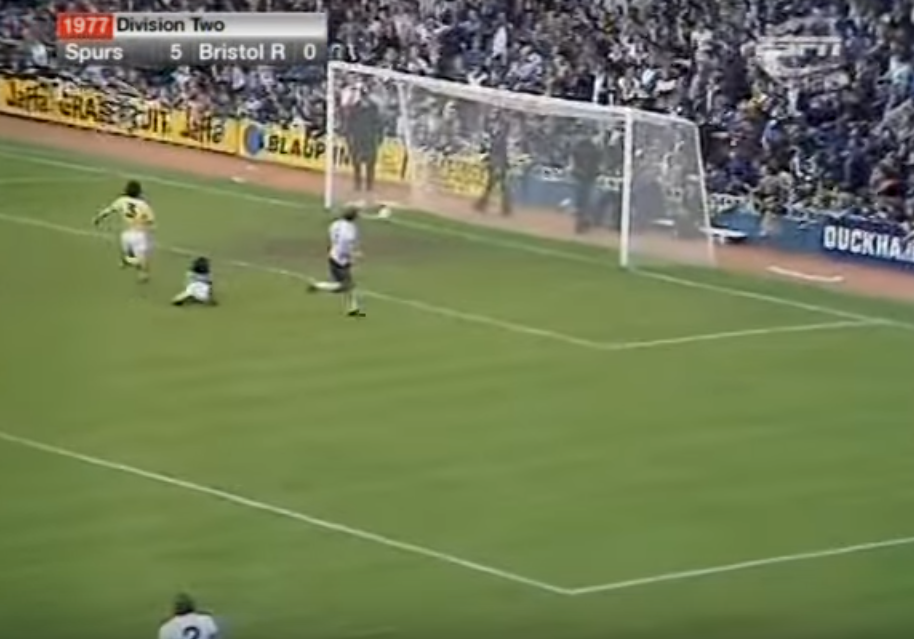
Jones then pulled off another good save when Taylor was able to shoot from outside the area to the keepers left and Jones parried it away.  Within minutes, though, Spurs inevitably added to their tally.  Hoddle flicked the ball forward to Taylor on the edge of the area and he turned it on for Moores to run ahead of Bater.  He then clipped the ball past Jones as the keeper came out.  Jones really wasn’t helped by his defence as Tottenham turned on the style

TOTTENHAM   6   -   0   BRISTOL ROVERS
Lee 3, Moores 2, Taylor


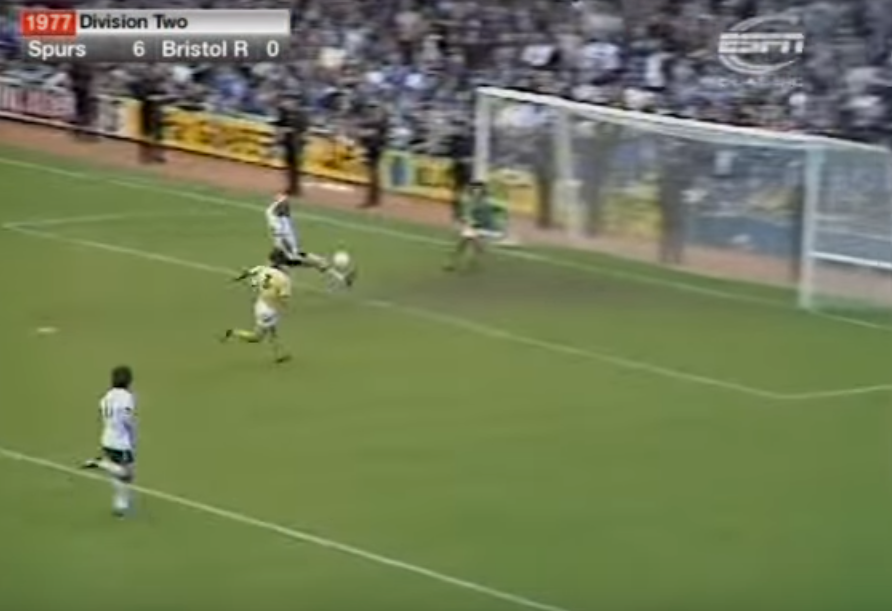
Soon after Moores also completed his hat-trick.  Nick Holmes played a long ball down the left where Lee was free and his ball into the box found Moores unmarked.  Moores stretched his leg out and let the ball hit his foot to wrong-foot Jones.

TOTTENHAM   7   -   0   BRISTOL ROVERS
Lee 3, Moores 3, Taylor


Two minutes from time and Spurs surged forward again as Hoddle found Pratt just inside his own half on the left.  He booted the ball down the wing and ran onto it but his cross was wayward and curled away from the area where Taylor latched onto it from outside the ‘d’.  His shot hit Bater and bounced to Lee who stabbed it home for his fourth goal of an astonishing day.

TOTTENHAM    8    -    0    BRISTOL ROVERS
Lee 4, Moores 3, Taylor


Then just before the final whistle Spurs had another corner on the right which Taylor took.  He curled it to the edge of the area where Rovers substitute, Paul Hendrie, inadvertently headed the ball to Moores on the left.  Moores looked up then floated a ball back to the far post where Hoddle, who looked a mile offside, slipped in and made it 9-0.

TOTTENHAM   9   -   0   BRISTOL ROVERS
Lee 4, Moores 3
Taylor, Hoddle


Tottenham: Daines, Naylor, Holmes, Hoddle, McAllister, Perryman, Pratt, McNab, Moores, Lee, Taylor
Bristol Rovers: Jones, Bater, Taylor A, Day, Taylor S, Prince (Hendrie), Williams, Aitken, Gould, Staniforth, Evans  
Attendance: 26,311

For seventeen years this remained the highest number of goals scored by one team shown on Match of the Day.  Tottenham looked odds-on for the title and an immediate return to the First Division, but they lost three in four towards the end of the season and had to battle out a 0-0 draw at Southampton just to go up on goal difference.  Ironically their goal difference was nine goals better than Brighton and their performance on this day clearly made all the difference.
Bristol Rovers ended the season in 18th, one point above the relegation zone.  Unbelievably they were one of seven clubs to finish just one point above the relegation places.
Colin Lee managed to secure a regular starting place and ended up with 11 goals for the season.  Ian Moores struggled to find a place ahead of John Duncan or Gerry Armstrong and only scored once more.

As for Glyn Jones, he received plaudits for his performance as many observed he’d been let down by his defence.  Jones didn’t make the starting line-up again until the beginning of January when he played against Cardiff at home (3-2) and Fulham away (1-1).  He was back in the reserves a week later and guess where his next match was?  Yes that’s right, at White Hart Lane albeit in front of a much smaller crowd than he’d witnessed that day.
The following season he only made four appearances before moving to Shrewsbury Town the following year.  In 1981 he moved to Shrewsbury but still struggled to find a regular starting place.  By the following season he was out of league football when he moved to Gloucester City.  He had further spells at Yeovil, Bath City and Newport County before finishing his career at Newport County.

It seems a shame when he clearly had some talent but for some reason managers just didn’t want to trust him with a prolonged spell in the first team.
He then moved into coaching and in 1997 he was appointed Director of the youth academy at Newport County and continued there until May 2014.  In October 2014 he was appointed goalkeeper coach at Forest Green Rovers.

In these days of footballers living in a goldfish bowl then the following days would've been full of footage of the teenager who had to pick the ball out of the net nine times in one match.  They'd interview his mum, his mates, his former school teacher and probably the newsagent who sold him panini stickers.  But Jones, despite appearing on Match of the Day, escaped without a great deal of fuss and was able to go through a coaching career where perhaps only a few knew of his 'fame'.