Showing posts with label Luton. Show all posts

Wednesday, 19 October 2022

The Greatest Stag Do : Part Six : The story of Mansfield Town's glory days : 1977-78


This is the story of Mansfield Town’s glory years of the mid-to-late 1970’s. So far in this story they won Division Four and then two years later, Division Three. They were about to embark on their first ever season in the second tier.

1977-78

Mansfield Town were formed in 1897. 80 years they had never been higher than the third tier of English football. 20 August 1977 they were embarking on their first ever match in the second tier. During the summer manager Peter Morris made two important acquisitions to bolster his squad for the tougher challenges ahead.

Dave Syrett was a 21-year old striker who’d been at Swindon playing under former Stags boss, Danny Williams. 30 goals in 122 appearances convinced Morris he was the man who could increase the firepower and take some of the pressure off Randall and Moss. If Stags’ fans were excited about the possibility of a Randall/Syrett partnership they were disappointed when Morris went with a Moss/Syrett combination.

The other signing was Pat Sharkey. Born in Omagh, Northern Ireland, he was bought from Ipswich Town. In four years he only made 18 appearances and probably welcomed the chance of first-team football and the challenge of Mansfield’s first ever second tier season.

When the fixtures came out Stags’ fans were overjoyed to find out they were at home for the first game. If they didn’t quite realise they were going to be up against some big names throughout the season they did as soon as they saw who their first opponents were. Stoke City were a First Division club the season before, suffering the drop by one point. In their side were England’s goalkeeper, Peter Shilton, Alec Lindsay, who’d won the league, UEFA and FA Cup with Liverpool, Howard Kendall, who’d won the league with Everton, Terry Conroy, capped 27 times for Republic of Ireland, as well as the experience of Denis Smith and Alan Dodd. They were managed by George Eastham, who was in England’s ’66 World Cup winning squad.

Before the league got under way they were in action in the League Cup. Lincoln City, then in the Third Division, came to Field Mill and walked off with a 1-0 win. John Ward scored the only goal of the game and four days later they defended it with a goalless draw. Mansfield’s League Cup run didn’t even yield a goal. Perhaps their minds were on bigger things?

Now for the league season. Stoke were one of the ‘big’ clubs Mansfield would come up against that season. A crowd of 14,077 packed into Field Mill to see the stars on show.

In the build-up to the game Morris had made the point he felt former First Division sides would find more problems at a lower level than those promoted from the Third Division.

Syrett and Sharkey were both in the side, with Randall on the bench. The first half was goalless but then five minutes into the second half Syrett pounced on a loose back-pass from Alan Dodd. He took his chance superbly, and even impressed the England goalkeeper.


Shilton said afterwards;

“How he got it past me I don’t know. I was perfectly placed to deny him any sight of the goal”.

Six minutes later Stags were in dreamland. Denis Smith handled in the area and Mansfield were awarded a penalty. The other new boy, Sharkey was given the responsibility of taking it. He had to wait up to four minutes before he could, though as Stoke fans invaded the pitch. But he kept his calm and beat Shilton to put the home side two goals up. Kevin Bird then thought he’d settled the game when he headed in from a corner, but it was ruled out for a foul on Shilton. But then in the closing minutes Ian Wood fouled Garth Crooks and the visitors had a penalty. Lindsay took it and scored but Stoke were unable to capitalise. Mansfield’s first game in Division Two ended with a 2-1 win.

Three days later they were up against a familiar opponent. Terry Venables’ Crystal Palace had taken on Mansfield four times in the last two seasons, and only been beaten once. But at Selhurst Park the Eagles had won both meetings. 45 minutes into this one and it was clear this wasn’t going to change. Palace were three-up by half-time. Syrett scored his second for his new club in the second half but it was no more than a consolation goal, as Stags went down 1-3.

They stayed down south to visit The Dell. The Saints were FA Cup winners just 15 months before, but were still a Second Division side. Lawrie McMenemy had added Alan Ball to his side, and with Chris Nicholl and Ted MacDougall also in the team they represented a tough task. David Peach scored from the spot in the first half and it remained the only goal of the game. The euphoria of an opening day win had now dissipated within a week with two defeats.

There was at least the home record, unbeaten in 38 league games. Brighton were the visitors at the beginning of September. Morris named an unchanged side for the fourth successive match, with Randall again on the bench. Alan Mullery had signed John Ruggiero from Stoke and after a couple of substitute appearances, he was in the starting line-up for the first time. He duly rewarded his boss with the opening goal. Steve Piper added a second and once again Syrett was on target and once again it was in defeat. This was proving to be a tough season already, they’d met the other two promoted sides who finished below them last season and lost.

Gone too was the unbeaten home run, stretching back to December 1975.

Changes were needed. One was forced as Ian MacKenzie picked up a knee injury. It was so bad fans would only see him pull on the yellow shirt once more in his career, and in the following summer he made the incredible decision to retire.

The other was a bit of a surprise. John Aston was a youth player at Matt Busby’s Manchester United. He was 10 at the time of the Munich Air Crash and was one of those Busby placed trust in to resurrect the club. At Wembley in 1968, on a pitch alongside players of the stature of Bobby Charlton, George Best, Nobby Stiles, Eusebio and José Torres, Aston was voted Man of the Match in United’s 4-1 win over Benfica in the European Cup Final. Four years later he moved to Luton Town and now Morris saw him as adding valuable experience to his team. Aston made his debut in the home meeting with Millwall. Another of Morris’ signings, John Miller, made way. The game ended goalless with Randall replacing Syrett but to no avail.

This was the end as far as Randall was concerned. He would later reflect he was at an age where he wanted to be playing, and four appearances as a sub just wasn’t doing it for him. He dropped down two divisions to York City. Randall has always been synonymous with Stags’ Third Division title season and remained a club favourite. Typically, he scored twice on his debut at Bootham Crescent.

Ian Matthews came in for his first appearance of the season for the trip to Cardiff City, in a game where Ernie Moss finally got off the mark in a 1-1 draw.

Burnley then rocked up at Field Mill still searching for their first win of the season. They’d been relegated from the First Division two years earlier. Despite having two talented wingers in Terry Cochrane and Tony Morley, Harry Potts’ side was struggling in front of goal. Of their two goals thus far one was an own goal. Ian Brennan’s first half goal was therefore a bit of a surprise, but Syrett was also on target as the two sides went into the break level.


In the second half Mansfield tore their opponents apart, which caused Morris to reflect how they had played in a way that Second Division football should be played. Aston was especially impressive and it was his good work down the left which created the space for a cross Hodgson gleefully converted. Three minutes later they were further ahead. Syrett, always a menace, was pushed over in the penalty area and Sharkey converted the penalty. It looked for minute as if Stevenson had saved it, but he lost his grip and it rolled over the line. Moss lobbed the Burnley keeper to round off the scoring for a 4-1 win. The only black mark was the sending off of the home side’s Colin Foster and the visitors’ Paul Fletcher as the two exchanged punches in the centre-circle.

Seven games in and they were lying 12th.

October

A week later they had back-to-back wins for the first time when they went to Hull City and walked away with a 2-0 win. Moss scored both against a side containing Billy Bremner, to register their first win on the road in the new division. Now they looked like they belonged.

But that was as good as it would get for October.

Defeats at Bristol Rovers and Bolton Wanderers were sandwiched either side of a draw at home to Sheffield United. Bolton were the early leaders, so this was no embarrassment but it was followed with successive defeats at home to Sunderland and Notts County. County had only picked up their first win of the season a week earlier, so this was a bad loss. The Sunderland result went largely under the radar as Tottenham thumped Bristol Rovers 9-0 on the same day.

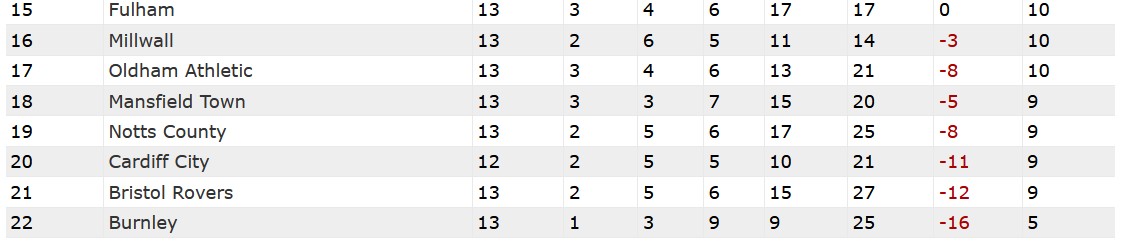
Sharkey missed both home defeats which saw Morris don his kit for the first time in the season, but he couldn’t galvanise his team. October ended with the side in 18th, one of four clubs on nine points with only Burnley on fewer.


November

Syrett and Moss had five goals each so far, and both added to this tally in a 2-2 draw at Charlton. Six games without a win finally came to end at home to Luton Town. Aston missed the game against his former teammates as Sharkey and Syrett gave the home side a half-time lead. Miller, who was back in for Aston, made it three with his first of the season. Morris made his 600th league appearance and was especially influential.

Sharkey scored his fourth of the season but it came in defeat at fifth placed, Blackburn. Next up was the visit of Oldham Athletic. The Latics arrived at Field Mill fourth from bottom. After winning two of their first three games, they’d won just one of their next 13. Striker Steve Taylor scored twice to give him seven in as many matches and Oldham came away with a convincing win.

They were back down into the bottom three. This would be a long winter.


December

The Stags travelled down to London to take on Orient at Brisbane Road. The O’s hadn’t won any of their last five matches, although only one of those was a defeat. John Chiedozie and Peter Kitchen put them ahead in the first half, with Kevin Bird getting one back for the visitors. This saw the first appearance of the season for Barry Foster. It was also the first appearance for John Goodwin, who’d just moved from Stoke City where he was struggling to find a first team place. He was the fifth new player in Morris’s side but he could do nothing to stop a third successive loss. Kitchen completed a hat-trick in the second half. He would go on to hit 21 goals that season.

Mansfield were now second from bottom.


Blackpool were next to visit together with their free-scoring strike partnership of Bob Hatton and Mickey Walsh. The two were both on target at Field Mill in a 3-1 win taking the losing run to four for the home side. That long unbeaten run seemed a distant memory, having lost four of their last five at home.

They travelled to Luton Town to try and reverse the trend. Morris dropped himself and would be seen only once more in the starting line-up for the remainder of the campaign. Syrett’s last goal had come against the same opponents five games earlier, and he took the opportunity to punish them again to take his tally to eight.

The club celebrated Christmas just a point above Burnley who were bottom. Yet they were still only a point from the two clubs immediately above them, so they were still in a battle for safety.

Fulham arrived on Boxing Day. Sadly for Stags’ fans had this fixture been played a year before they might’ve been witnessing Bobby Moore, Rodney Marsh and George Best. Moore had retired, Marsh moved to the States, and Best had called time on his term at Craven Cottage six weeks before this game.

John Mitchell, who’d been a key part of Fulham’s road to the FA Cup Final two years earlier, gave the visitors the lead at the break. But just as the home fans feared a sixth home defeat of the season, goals from defenders, Colin Foster and Kevin Bird turned things around. They’d endured five games since their last victory, and at last they could celebrate.

But the Christmas period was always a busy one in those days, and 24 hours later they made their way to London to take on Spurs. Tottenham’s 26-year residency in the First Division had come to an end in the previous season. They were second in the table, two points behind Bolton and two points ahead of Blackburn, in third.

Manager Keith Burkinshaw had largely stuck with the same team which went down, just adding strikers Colin Lee (Torquay) and Ian Moores (Stoke), though both were absent from this game. But they did contain future England managers, Glenn Hoddle and Peter Taylor.

It would be the biggest crowd many of these Mansfield players ever played in front of, 36,288.

John Duncan gave the home side the lead in the first half, with his 11th of the season. Bird scored his fourth of the season and Mansfield bravely earned a point.


After four defeats three games unbeaten was a great tonic and hopes were high of finishing off the year in good spirits. Crystal Palace visited on New Year’s Eve. They were a much changed side from the one which beat Mansfield in their first away trip of the season. Only five players remained. They were also coping with the rigours of Second Division football much better than their hosts. Terry Venables was compiling an exciting young team and one of those tipped for higher things was left-back Kenny Sansom. He opened the scoring in the first half inside the opening 10 minutes. Barry Silkman played him in and he was given far too much time to shoot.

More defensive errors were to follow, and for manager Morris it must’ve been particularly galling to come so soon after his half-time team talk. The defence froze waiting for an offside flag which never materialised, allowing Dave Swindlehurst the simplest task of beating Arnold. Three minutes later they decided to leave him unmarked and consequently Sansom’s header across the area found him and he made it 3-0.

John Aston got a consolation goal, but it was a sorry end to a promising run, causing Morris to comment after the match;

“We made mistakes at the back which you don’t expect from a schoolboy playing on a local recreation ground. That’s the third time this season we have been on the makings of a good run and failed to keep it going.”

Palace were up to eighth, seven points off promotion. But the evenness of the points distribution that season was such they were only eight points better off than the Stags. They were lying 20th, two points from safety.

The euphoria and celebrations of Third Division title success back in May seemed a little distant now. It was going to be a long 1978.


All pics courtesy of Stagsnet & The Chad

Friday, 28 November 2014

A Moment in Time - When Aston Villa were Relegated - 1986-87


The season is 1986-87.  It is 5 years since Aston Villa were League Champions, 4 years since they were kings of Europe.  In January 1983, they beat Barcelona to win the European Super Cup.

After the European Cup success, their final league positions had been on a steady decline

1982-83 – 6th
1983-84 – 10th
1984-85 – 10th
1985-86 – 16th

From the squad that played in the season, ’86-’87, only 5 players remained from either their league title or European Cup winning sides.  Gone were players such as Gordon Cowans, midfield talisman who was now in Italy, Dennis Mortimer, the inspirational captain, Tony Morley, speedy winger and Des Bremner.

Ironically, Villa had begun to compile a team full of young players who would go on to have decent professional careers.  Players such as Tony Dorigo, Steve Hodge, Tony Daley, Mark Walters.  All four were later capped by England.  Dorigo was part of the Leeds United League title winning side of 1991, Hodge was part of a Nottingham Forest side runners-up in the FA Cup in 1991.  Walters won an FA Cup winners medal with Liverpool in 1992.  There was also Paul Elliott, who went on to have a promising young career with Chelsea.

Many Villa sides were compared to the 1981 squad when just 14 players were used.  This time round, Villa would call up 26.  Injuries and loss of form are never helpful when you’re fighting for survival, and this season was no exception.

The play-off system had recently been introduced and in these early days the First Division was included.  The bottom three clubs would be automatically relegated, but the club finishing 19th would go into a play-off competition with three clubs from the Second Division.  The FA was trying to reduce the number of teams in the First Division gradually each season so only two clubs would automatically come up from the Second Division, but a third could get promoted at the expense of the 19th placed First Division side.  So, to ensure First Division survival a club would need to finish at in at least 18th place.


Manager


Graham Turner, age 39 – Had a playing career with Wrexham, Chester and Shrewsbury which spanned 19 years.  As player-manager of Shrewsbury they won Third Division title.  Took over Aston Villa in 1984.  After leaving Villa Park, he moved to Wolves for 8 years, and then onto Hereford where he spent 14 seasons as manager.


Billy McNeill, age 46 – Part of Celtic team that won the European Cup in 1967.  Managed Clyde, Aberdeen, Celtic and Manchester City before taking over at Villa Park once Turner was sacked.  Lasted until the end of the season, when he returned to Celtic.

Squad

Goalkeepers


Kevin Poole (age 23, 11 apps) – Turned professional with Villa in 1981.  Spent 6 seasons there before moving to Middlesbrough in 1987.


Nigel Spink (age 28, 38 apps) – Made his name when he came on as a sub for Jimmy Rimmer in the European Cup Final in 1982.  Then became the regular keeper at Villa Park, spending 19 years there, before moving to West Brom in 1996.

Defenders


Gary Williams (age 26, 26 apps) – Began his career at Villa in 1978, one of the survivors from their League and European triumphs.  Left Villa at the end of this season to move to Leeds United.


Tony Dorigo (age 20, 48 apps) – Born in Melbourne, but played for 15 times for England.  Made his debut for Villa in 1984, remained at the club before moving to Chelsea at the end of this season.  Later won a League title with Leeds United.


Allan Evans (age 29, 33 apps, 7 goals) – Another survivor from the title winning team.  Joined from Dunfermline in 1977, and eventually played 380 times for Villa before moving to Leicester in 1989.


Paul Elliott (age 22, 37 apps, 5 goals) – Began his career at Charlton before moving to Luton in 1983 and then onto Villa, 2 years later.  Left the club at the end of the season moving to Pisa in Italy.


Martin Keown (age 20, 42 apps) – Began his career at Arsenal in 1984 and then moved to Villa in 1986, spending 3 years there before moving to Everton and then back to Arsenal.


Dave Norton (age 21, 25 apps) – Scottish born, he signed as an apprentice at Villa in 1981, but didn’t make his debut until 1985.  Eventually left the club in 1988 when he moved to Notts County.  Had his most successful time, in terms of playing, at Hull from 1991.


Dean Glover (age 22, 5 apps) – Signed professionally for the club in 1981 and was another who left after this season, moving to Middlesbrough.  Later played and then managed, Port Vale.


Bernard Gallacher (age 19, 1 app) – Scottish born, signed at Villa as an apprentice in 1985.  Only made his debut for the club in the final game of this 86-87 season.  Stayed at the club until 1991 when he moved to Doncaster.

Philip Robinson (age 19, 3 apps) – Began his career at Villa in 1985 and then moved to Wolves two years later.  The games he played during this season were the only appearances he made for the club during his career.

Midfield


Andy Blair (age 26, 4 apps) – Began his career at Coventry in 1978, moving to Aston Villa during their League Championship season.  Spent 2 years at Sheffield Wednesday in 1984, before moving back to Villa Park at the start of this season.


Steve Hunt (age 30, 46 apps, 4 goals) – Began his career at Villa in 1973.  After 4 years he spent time at New York Cosmos before returning home to Coventry.  Spent 2 years at West Brom before joining Villa in 1986.


Steve Hodge (age 23, 21 apps, 6 goals) – Started his career at Nottingham Forest in 1980, spending 5 years there before moving to Villa in 1985.  Left the club during this season to move to Tottenham, before going back to Forest in 1988.  Won 24 caps for England.


Tony Daley (age 19, 38 apps, 4 goals) – Joined Villa as an apprentice, making hisdebut in 1985.  Spent 9 years at the club making over 230 appearances before moving to Wolves.  Played 7 times for England.


Mark Walters (26 apps, 4 goals) – Also began his career at Villa as an apprentice, making his debut in 1982.  Spent 6 years at the club, before joining Rangers and then moving onto Liverpool in 1991.


Paul Birch (age 23, 35 apps, 4 goals) – Came through the youth system at Villa, making his debut in 1983.  Came on as a sub in the Super Cup win.  Stayed with the club until he moved to Wolves in 1991.


Neale Cooper (age 23, 15 apps, 1 goal) – Began his career at Aberdeen where he won League, Cup, League Cup and European Cup-Winners Cup medals.  Signed for Villa during the summer 1986.  Struggled with injuries during his 2 years at the club, and moved back to Rangers in 1988.


Paul Kerr (age 22, 6 apps, 2 goals) – Began his career at Villa, making his debut in 1982.  Only made 24 appearances until he moved to Middlesbrough in 1987.

Strikers


Simon Stainrod (age 27, 35 apps, 8 goals) – Began his career with Sheffield United in 1975, moving to Oldham in 1979 and then QPR a year later.  After a short spell at Sheffield Wednesday, he joined Villa in 1985.  Left in 1987 and had spells at a further 6 clubs before the end of his career in 1995.


Garry Thompson (age 26, 37 apps, 7 goals) – Began his career at Coventry in 1977.  Spent 6 years there before he moved to West Brom and then Sheffield Wednesday, joining Villa at the start of this season.  Joined Watford in 1988.  Later went on to manage Bristol Rovers.


Gary Shaw (age 25, 1 app) – His goals played a major part in Villa’s success in the early ‘80’s, but injuries restricted his appearances during this season, to just 1 game.  Eventually left the club in 1988.


Andy Gray (age 31, 22 apps, 2 goals) – Started his career at Dundee United, before moving to Villa in 1975, winning a League Cup winners medal.  He joined Wolves for a record transfer in 1979, winning another League Cup.  He then joined Everton in 1983, winning a League Championship in 1985.  Moved back to Villa for his 2nd spell in 1985, when Gary Lineker joined Everton.  Not as successful in his 2nd spell, leaving in 1987 having scored just 5 goals.

Warren Aspinall (age 19, 12 apps, 3 goals) – Started his career at Wigan in 1985, before moving to Everton a year later and then Villa in February 1987.  He joined Portsmouth in 1988 for whom he played more games for than anywhere else.

Mark Burke (age 18, 1 app) – Turned professional during this season, making his debut for the club.  Later in 1987 he moved onto Middlesbrough.


Tony Barton had been in charge of Villa when they won the European Cup in 1982.  He remained in charge until the summer of 1984, when he was sacked.  Villa had become disappointed with the league finishes since the European win, and wanted a new direction.  They appointed Graham Turner, a young up-and-coming manager at Shrewsbury.  As a player-manager he had guided them to the Third Division title in 1979.  By the start of the 1986-87 season, there were already concerns about Turner’s ability.  Not only did they look a long way from competing in Europe, but they’d finished just 3pts ahead of the relegation zone the previous season. 

The season kicked off at home to Tottenham.  Clive Allen put the visitors in front after just 4 minutes, and then when he got his 2nd goal, 20 minutes later, gloom descended The Holt End.  Allen completed his hat-trick in the second half and Villa had been beaten, 0-3 at home on the opening day.

Three days later, they travelled to Plough Lane to meet Wimbledon.  This was Wimbledon’s first season in the top flight after just 10 seasons in League football, and so their first home game was eagerly anticipated, and again Villa conceded an early goal as Glynn Hodges put the home side in front after 9 minutes.  Things just got worse for Villa as Gary Williams was sent-off 4 minutes after they went behind, but then Steve Hodge was brought down in the box and Allan Evans converted the penalty to equalise.  John Fashanu then restored The Dons lead right on half-time.  4 minutes to go and Evans then gave away a penalty himself, and Gage converted.  Garry Thompson did get one back for Villa, with his first goal for the club since his summer move from Sheffield Wednesday. But Villa lost 2-3 and had begun the season with 2 defeats.


After losing again, 0-1 away to QPR, they then entertained Luton Town at Villa Park.  Two goals from second half substitute, Paul Kerr, gave Villa their first win of the season, 2-1.  Their joy was short-lived as they were then beaten at home by Oxford United, 1-2.

Oxford had enjoyed their finest period in their history, after they won the Second Division title in 1985.  They’d finished just 1pt above the relegation zone in 1986, beating Arsenal 3-0, on the final day to stay up.  Oxford were a mixture of honest professionals and ‘journeymen’, such as Dave Langan, John Trewick along with Ray Houghton and John Aldridge.  Oxford were again expected to be relegation candidates, and so this defeat was another nail in Turner’s coffin.

Worse was to follow.  Villa visited the City Ground to meet Nottingham Forest.  After losing on the opening day to Everton, Forest had won 3 of their next 4 matches.  Villa met them at just the wrong time.  Garry Birtles and Neil Webb both scored twice, with Franz Carr and Nigel Clough also scoring as Forest ran out 6-0 winners.

This was all too much for new chairman, Doug Ellis and the axe fell on Turner.  Forest would go on to hit Chelsea for 6 the following week, but that was little consolation for Villa who searched for a new manager.

Sacked

Billy McNeill was in charge at Celtic and had lead them to 3 League titles, 1 Scottish Cup and 1 League Cup success.  In 1983 he moved to Manchester City who were then a Second Division side, and guided them to promotion to the First Division.  McNeill had been touted for the job at Old Trafford, before Ron Atkinson got it.  Villa were a whole new challenge for the man who had captained the first British side to win the European Cup.  They were 21st in the table, although Man Utd were only 2 places above them.

If McNeill was not certain of the task ahead of him, his first game should have made it abundantly clear.  They were at home to Norwich City and were thumped, 1-4, and moved to the bottom of the table.  Next up, a trip to the champions at Anfield.  Both teams had been involved in League Cup (now Littlewoods Cup) action in the week, and their fortunes could not have been more contrasting.  Villa were held, 1-1 at Second Division side, Reading.  Liverpool thrashed Fulham, 10-0.

Villa produced a decent performance to come away with a 3-3 draw with goals from Hodge, Thompson and another penalty from Evans.  Villa were bottom of the table with just 4pts from 8 games.

October

Villa then travelled to Midlands rivals, Coventry and it was an ex-sky blues player who scored the only goal of the game.  Garry Thompson had spent 6 years at Highfield Road, and was a delighted scorer to give Villa only their 2nd win of the season.  Unfortunately for Villa this would remain their sole away win all season.

This took Villa off the bottom of the table, and they went on to beat Reading in the 2nd leg of their League Cup tie, where Andy Gray scored twice.  Gray had returned to the club for his 2nd spell, and these were his only goals of the season.  They then won 3-1 at home to Southampton in the league, where Paul Elliott scored twice and Evans converted his 3rd penalty of the season.  This put Villa up to 18th.  For younger readers, it may surprise you to know the 4 clubs below them were, Chelsea, Man Utd, Newcastle and Man City.

The mini-revival took a jolt as they went to Watford and were beaten, 2-4.  But they managed to bounce back with 2-0 wins over both Newcastle and Leicester.  Steve Hodge bagged a brace against Newcastle and Simon Stainrod did the same against Leicester.  Villa had now picked up 13pts from a possible 21 and Stainrod had found the net 4 times.  Things seemed to be on the up, as they were up to the heady heights of 16th


November

Then things took a turn for the worst.  Although they got past Derby in the League Cup after a replay, their league form hit the buffers and they went 7 games without a win.  They went to Maine Road for McNeill’s return to his old club, but City youngster, Paul Moulden, scored his first goals for the club with a double as City won 3-1.  After draws against Chelsea (0-0) and West Ham (1-1), they were then thumped at home, 0-4 by Arsenal. Ironically, future Gunner, Martin Keown, scored an own goal, as Perry Groves, David Rocastle and Martin Hayes took advantage of some poor defending. 

December

Allan Evans scored his 4th penalty of the season but they were beaten, 1-2 at Sheffield Wednesday, and then scored another when they held Man Utd to a 3-3 draw at Villa Park.  Just before Christmas a late penalty from John Aldridge denied Villa a win at Oxford, but finally the run ended on Boxing Day when Charlton were the visitors and goals from Birch and Daley gave Villa a 2-0 win.

Christmas was an important period for most clubs, and for Villa they had 3 games against sides in the bottom half, 2 of them below Villa.  They went to Oxford and drew, 2-2, and then came their victory over Charlton.  The day after, they travelled to Stamford Bridge.  Chelsea were bottom of the table, scoring just 21 goals in their 21 matches.  They won on Boxing Day, beating Southampton, 2-1.  This was their first win for 9 games, and ended a run of 1 win in 12.  Aston Villa were just the boost Chelsea needed.  They won 4-1, as Kerry Dixon scored twice.  Villa had become one of 9 wins Chelsea would have in a 13 game period, which ultimately saved their season.  But for Villa, this begun an even more desperate run than the Charlton victory had ended.

At the end of the year, Villa were in 18th place, just 2pts above the bottom club, Leicester.


January


January was a dreadful month for Villa.  They didn’t win a single game.  They didn’t score in three league games and were knocked out of the FA Cup by Chelsea, albeit in a replay.  They suffered two further defeats into February, at home to QPR and away at Luton.  This stretched their run to 1pt from the last 6 games, and 1 win in their last 14.  Villa were now entrenched in the bottom three.  Evans scored his 6th goal of the season, all from the spot, against Luton.  It was their first goal in the league for 5 matches.  They had lost three successive matches and 5 from their last 6.


On the back of that form, they had to welcome Liverpool to Villa Park.  Liverpool had just won their last 4 matches.  But Villa managed to produce a dogged performance and gained a 2-2 draw.  This was followed by draws against Norwich (1-1) and Wimbledon (0-0).  Their losing run had come to an end, but they had gone 9 games since their last win.


March

They were then due to take a trip to St. James’s Park to play the bottom club, Newcastle United.  The last time they played ‘the bottom club’, they lost to Chelsea.  Nothing changed this time either, as Tony Cunningham took advantage of some slack marking to give the home side an early lead.  Just before the break, Tony Daley then delicately chipped the keeper to equalise and silence the crowd.  In the second half a good run and low shot from Peter Beardsley won it for Newcastle and Villa lost, 1-2. 


They were away next to Southampton, who themselves were looking over their shoulder.  The Saints were just 4pts ahead of Villa, in 17th and 2pts above the drop zone.  You wouldn’t have thought the two teams were so close as Villa were easily beaten, 0-5.  Northern Ireland international, Colin Clarke, scored twice as Southampton were 4-0 up by half-time.  Villa managed to secure a 1-1 draw when Watford visited and then finally the run ended.

At the end of March, Coventry were the visitors.  Villa had beaten their neighbours back in October, but with Coventry in 8th place, it looked as if there was little hope.  Birch scored the only goal of the game and Villa had done the double over Coventry, which would at least give some fans cause to celebrate.  Villa had gone 12 games since they last won, on Boxing Day, and this win had been a long time coming.  The win took Villa out of the relegation zone, albeit by 1pt, but they had still played a game more than the teams below them.


April

Eight games to save their season and some big games to come.  On 4th April four of the bottom five clubs met.  Villa entertained Man City at Villa Park.  City were bottom, but this time Villa managed to avoid defeat with a 0-0 draw.  The relegation battle was hotting up and despite avoiding defeat, Villa dropped two places.  Goals from Ken Wharton and Paul Goddard gave Newcastle a crucial 2-0 win against Leicester, and an exciting game at Selhurst Park where Charlton beat Watford, 4-3.  By the time Villa were next in action they were now 4pts from safety and they were again up against another side battling relegation, when they met Leicester at Filbert Street.  Mark Walters scored his first goal since before Christmas, but former Southampton striker, Steve Moran, equalised for the home side and the game ended 1-1. 

Villa had now gone 4 games without defeat but with Newcastle continuing to pick up points, Villa were still 4pts behind them having played a game more.


Newcastle then extended their unbeaten to run 8 as Paul Goddard scored in his 6th successive game to give them a surprise 1-0 at Highbury.  Man City then grabbed a 1-1 draw with 3rd placed Tottenham and the gap on Villa had closed to 1pt.  The Easter weekend began with League leaders, Everton were next to visit Villa Park.  They fought hard but a Kevin Sheedy goal saw Villa lose, 0-1.  Charlton and Man City both lost and all three looked distinctly desperate with just 5 games to go.  Newcastle won again, this time beating Man Utd 2-1 with Goddard now extending his run to scoring in 7 consecutive matches. 


It was looking like the play-offs would be the only hope for Villa with them needing 7pts to be safe and only 5 games to go.


Next up was the type of game we now call a ‘relegation 6-pointer.  Charlton were immediately above Villa in the table, with the two separated by 1pt.  It all went wrong for Villa, and Charlton came away with a crucial 3-0 victory, with goals from Peter Shirtliff, Mark Stuart and Jim Melrose.  Things were now extremely desperate for Villa, they were 9pts from safety and even 7pts from a play-off place and fast running out of matches.


Then they managed to pull a great result out of the bag.  West Ham visited Villa Park.  They were 14th in the table, with little to play for.  Villa took advantage and Warren Aspinall chose this match to score his first goals of the season, as he scored twice and Villa won, 4-0.  This was Villa’s biggest win of the season, although only 13,500 saw it, but it seemed really out of character, as they’d won just 1 in their last 17.  Elsewhere, two goals from Imre Varadi helped Man City beat Arsenal, 3-0, as another Melrose strike earned a point for Charlton at Southampton. 

Three games to go, could Villa pull off a remarkable escape? It was looking unlikely with 2 of those matches away from home at Arsenal and Man Utd.


May

May 2nd saw Villa visit Highbury to meet 4th placed, Arsenal.  Aspinall was again on target, but a Martin Hayes double meant Villa lost, 1-2.  Their only comfort was the three sides immediately above them all lost, but Man City earned a valuable point at Everton and now Villa were bottom of the table.  They now needed to win their last 2 matches otherwise it was relegation.  The most remarkable result of the day was at Hillsborough where Sheffield Wednesday dispelled any potential relegation worries when they thumped QPR, 7-1.  Goals from David Hirst (2), Brian Marwood (2), Mel Sterland, Gary Megson and Mark Chamberlain.

Sheffield Wednesday were then Villa’s next opponents on Bank Holiday Monday at Villa Park.  May 4th 1987 was a black day in Villa history.  The game was memorable for Phil Robinson who scored his debut goal in professional football.  But it wasn’t enough, Villa lost, 1-2 with David Hirst and Lee Chapman scoring and that was it.  Every other club around them picked up points.  Imre Varadi scored the winner when Man City beat Nottingham Forest.  Leicester drew 1-1 with Coventry and goals from ex-Tottenham players, Paul Miller and Garth Crooks helped Charlton win 3-0 up at Newcastle. 

AstonVilla were relegated, just 6 years after their famous League Championship.  They would need win their final match by 13 goals to avoid finishing last.  Their final match was a visit to Old Trafford.  Paul Birch scored the final goal of Villa’s First Division season, but goals from Mike Duxbury, Bryan Robson and Clayton Blackmore gave Man United a 3-1 win.


Aston Villa had finished 2nd to Manchester United in the Second Division in 1974-75, to win promotion to the First Division.  During their time there, they won 2 League Cups, 1 League Championship, 1 European Cup and 1 European Super Cup.  But now it was all over.  Second Division football beckoned from August 1987.

For manager, Billy McNeill, he earned the rather unusual accolade of managing two relegated clubs in the same season, as Manchester City also went down.  At the end of the season, McNeill stepped down and returned to Celtic.  Villa then appointed Watford manager, Graham Taylor, who got them back up straight away.  But that is for another day.